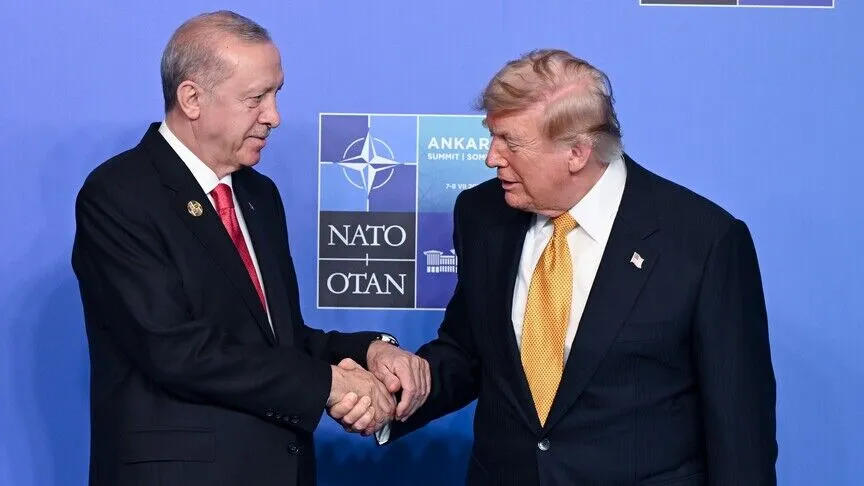
A Test For Unity?
Ankara welcomed heads of state and government from all 32 NATO members, alongside invited leaders, nearly 100 ministers, senior diplomats, representatives of international organisations, and thousands of foreign guests. Türkiye hosted the 19th Nato Summit in 2004 in Istanbul. There were strict security measures in Istanbul throughout the summit since the Turkish government was afraid of a terrorist assault. The unexpected transfer of Iraqi sovereignty, which coincided with the first day of the NATO summit on June 28, pushed the summit itself off the front pages of the international press. Meanwhile, protesters from all over the world gathered to demonstrate against the US foreign policy under the George W. Bush administration.
22 years later, Türkiye once again is the organiser and security measures were at their highest level. Two months before the summit, roads were built, buildings close to airports and the presidential palace were painted at no cost by the government. Ankara saw the summit as a huge chance to show Türkiye as a major power inside NATO. The Turkish government utilised all security resources for the summit, and there were 56,000 police and gendarme forces active in Ankara. Three airports in Ankara were actively operational for visitors within the scope of the summit.
What all the leaders were expected to talk about was NATO 3.0. As Pentagon policy chief Elbridge Colby puts it, the aim is a NATO 3.0 based not on dependency but partnership within the organisation. This objective faces growing complexity amid three major challenges: the Trump administration’s interest in Greenland, uncertainty surrounding the U.S.–Iran war, and the proposed 5% defence investment commitment. Diplomats and NATO officials say countries have been asked to hold off announcing major deals to create a bigger effect in Ankara.
Under Trump, the U.S. insists on Europe taking the lead in the region for defence and security spending, and the European leaders acknowledge that and try to step up the process. “Except for the fact that it was being held in Turkey by President Erdoğan, I don’t think I would have gone to it,” Trump said. While Trump has frequently clashed with European leaders, his relationship with Erdoğan remains a distinct exception, and Türkiye’s huge presidential palace is expected to be one of the main interests.
For President Erdoğan, one of the essential things to showcase is going to be Türkiye’s fast-growing defence industry amid aspirations for stronger EU ties. Another topic that is going to be on the table is Ukraine. While European leaders recently secured a 4 billion dollar deal for Patriot interceptors and other U.S equipment this year, with the U.S-Iran conflict, it seems harder for Ukraine to get a bigger deal. NATO leaders know that they can’t just ignore the Middle East; they must factor it into their calculations on Ukraine.
This year, NATO hosted the largest industrial forum in its history as part of the Ankara Summit. Türkiye, being the second-biggest army in NATO, has been strengthening its military capabilities in recent years. Turkish Armed Forces (TSK) is increasing its personnel numbers, as well as its special commando units. At the same time, the production capacity of the Turkish defence industry is rising, and defence cooperation with NATO allies is developing faster since the last summit in The Hague. With the increasing capabilities, the Turkish defence sector has also recently become a major player in the European defence market. The growing number of contracts Turkish defence companies have secured with European allies is evidence of this trend.
After all these expectations, the summit exceeded the expectations of the heads of states. At the summit, the 5% goal was reaffirmed, with a further commitment for the next summit.
Right after the arrival in Ankara, U.S President Donald Trump’s announcement that Washington intends to lift sanctions on Türkiye could mark a potential turning point in bilateral relations. Trump also said he is working with U.S. Secretary of State Marco Rubio and Defence Secretary Pete Hegseth to finalize the decision, and it could lead to Türkiye’s reassessment of the F-35 programme.
NATO Secretary General Mark Rutte revealed new multinational collaborations in surveillance, space, long-range fires, command and control, air platforms, submarines, and a vast drone and counter-drone marketplace, worth 50 billion dollars, in Ankara. Furthermore, he introduced NATO’s new Front Door to Industry, a programme for crucial supplies and supply chains, NATO Engine (a network of industries), and an additional 217 billion dollars in financial commitments from banking.
Middle East expectations were largely unmet, with the summit’s communiqué featuring only a brief statement on Iran’s peace process, which was urged by President Trump. There was a push from Putin to Trump three months before the summit to stop new aid packages. After the summit, there was an opposite, warm moment between Zelenskiy and Trump, and it was revealed that Ukraine pledged a robust 70 billion euros for 2026, with commitments extending into 2027.
As expected, Trump repeated his threats to annex Greenland, part of the Kingdom of Denmark, at the start of the NATO Ankara summit, and the answer from the Danish Prime Minister Mette Frederiksen was strong and comprehensive against Trump. At the same time as the Greenland problem, Trump once again tried to sideline Spain from the center because of its ongoing stance on the Iran war.
Consequently, NATO 3.0 will operate with a narrower scope and a harder power posture against threats. As the Trump administration puts it, “irrelevant or unnecessary” missions and partnerships will be discontinued and the Ankara summit served as a test of this new approach.
The 2026 NATO Summit in Ankara marked a shift toward “NATO 3.0,” focusing on increased defence spending and burden-sharing. Key outcomes included U.S. plans to lift sanctions on Türkiye, 70 billion dollars in aid for Ukraine, new multinational defence deals, and heightened tensions over Greenland.