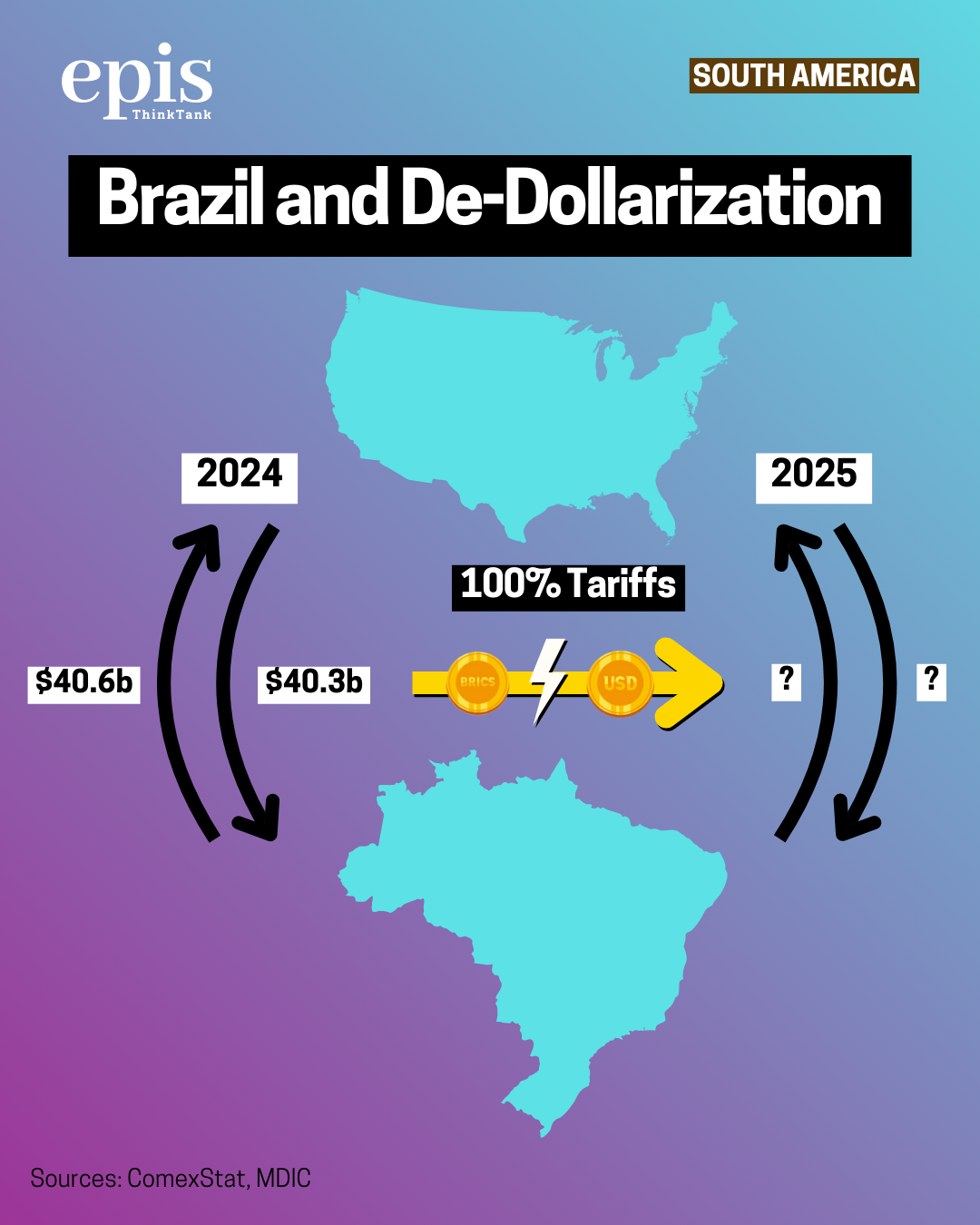
In this context, Brazil ascended to the group’s leadership on January 1st, 2025, under the motto “Strengthening Global South Cooperation for More Inclusive and Sustainable Governance”. The nation delineated two fundamental axes of action: Global South Cooperation and Global Governance Reform. As the lead nation, Brazil will coordinate the working group meetings to articulate the priorities of its presidency. Within the framework of Global Governance Reform, which principally addresses the de-dollarization of BRICS, Brazil has established as its first priority the “facilitation of trade and investments between the group’s countries through the development of payment methods”.
In pursuit of this agenda, Brazil aims to advance the de-dollarization initiative throughout its mandate while strengthening the role of the New Development Bank (NDB), under the leadership of former Brazilian President Dilma Rousseff. These measures aim to increase the bloc’s financial sovereignty and foster economic integration that better aligns with its members’ strategic interests.
In parallel, upon assuming the BRICS presidency for 2025, President Lula declared that “Now is the time to advance in creating alternative payment methods for transactions between our countries. It’s not about replacing our currency. But we need to work so that the multipolar order we aim for is reflected in the international financial system.” In response, newly inaugurated U.S. President Trump issued a warning, declaring his intention to implement 100% tariffs on BRICS member nations if they proceed with their alternative currency initiatives. He emphasized that any substitution of the American currency would be deemed unacceptable.
Despite significant policy divergences between Brazilian President Lula and newly elected U.S. President Trump, the Ministry of Foreign Affairs (Itamaraty), maintaining its historically measured diplomatic position, has signaled its commitment to preserving bilateral relations while preventing them from being contaminated by political and ideological discord.
The trajectory of BRICS’ positioning vis-à-vis the United States under Brazilian leadership remains to be determined through forthcoming diplomatic engagements. The inaugural meeting of the Brazilian presidency scheduled for February, coinciding with the immediate aftermath of Trump’s inauguration, and the subsequent BRICS Summit, set for July in Rio de Janeiro, will prove critical in establishing the year’s strategic priorities and operational agenda.