The Daunting Metrics of Arms Production in Russia and the EU
With the US election coming up in a few weeks, bringing an uncertain future for continued US support to Ukraine, Europe might have to provide the majority of weapons support to Ukraine in the future. However, this prospect is daunting when looking at the figures of war material supply for 2023.
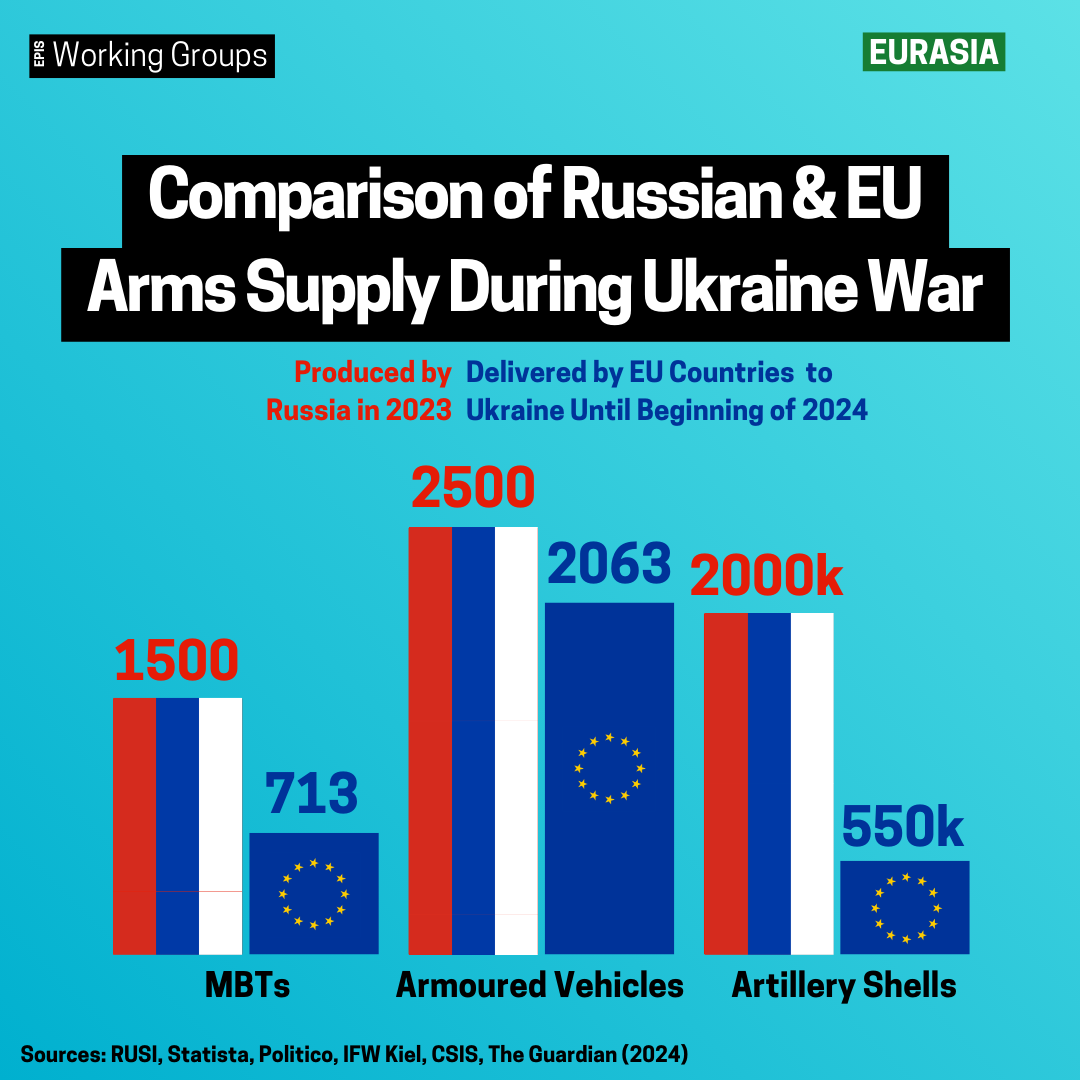
Russian vs. EU Production CapacitiesWestern analysts estimate that Russia produced up to 1500 main battle tanks, 2,500 armoured vehicles, and 2,000 artillery shells in 2023 alone. In comparison, EU countries managed to deliver 713 main battle tanks, 2063 armoured vehicles, and around 500,000 artillery shells to Ukraine until the beginning of 2024.
It must be mentioned that up to 86% of the main battle tanks produced by Russia were actually old, refurbished models and not completely new tanks. At the same time, however, European countries almost exclusively delivered material from old stocks, because the capacity to produce new material is in the low double digits annually. Considering that the stock of old Russian tanks is estimated to be over 5000 units, western analysts assume that Russia could keep this mode of production up for another two to four years.
While the quality of European gear continues to be higher compared to Russian arms production, the quantity at which these weapons can be produced pales in comparison to the Russian production capacity.
Structure of the Russian and European Arms IndustryAfter a year of fighting in Ukraine, the Russian economy has completely switched to a wartime economy, with an estimated 7% of GDP going to arms production. Whereas oil has been the major economic factor in Russia for years, it is now arms production. Oil merely serves as a way of financing this economy. The Russian arms manufacturing sector currently consists of almost 6000 companies, which are mostly relatively inefficient and have been subsidised by the state since the collapse of the Soviet Union. However, despite these economic inefficiencies and costly subsidies, this broad industrial base enabled Russia to quickly mobilize a wartime economy. European arms producers on the other hand have been geared towards economic efficiency, which is why they run much smaller outfits that are geared towards individual manufacture instead of mass production. Whereas Germany is currently able to produce around five to six Panzerhaubitze 2000 per year, Russia produces around 40 howitzers per month.